Phones for Runners & Cyclists (UK 2026) – GPS, Safety & Battery Picks for Training
A practical UK comparison of three Android phones for runners and cyclists, covering GPS, safety tools, battery endurance, weather resistance and carrying comfort.
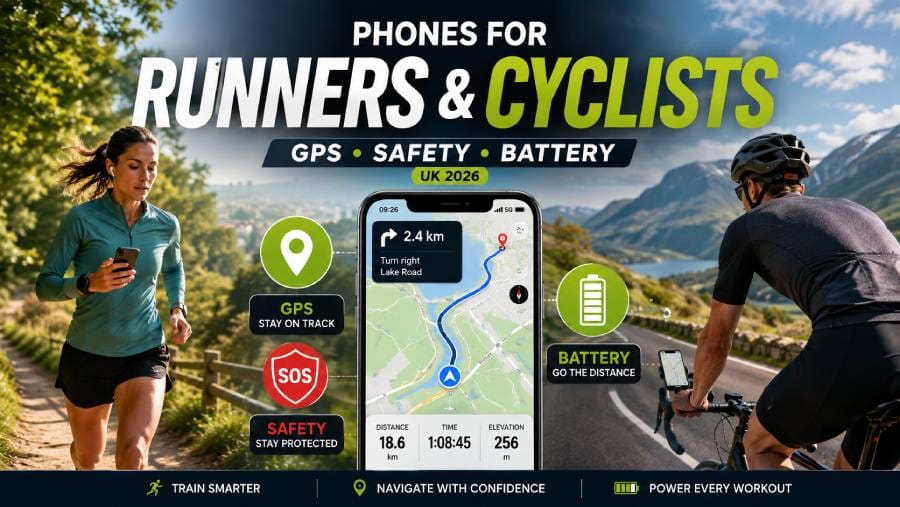
An all-day sportive with navigation running, a solo trail run beyond reliable mobile coverage and a regular commute in changeable weather put very different demands on a phone. Updated for UK buyers in 2026, this guide ranks the OnePlus 15 first for its exceptional stated battery reserve and fast charging, while the Google Pixel 11 is the better safety-led choice and the Samsung Galaxy A57 5G is the strongest mainstream value option.
🥇 OnePlus 15 — Best overall for long training sessions → Check price on Amazon UK
🥈 Google Pixel 11 — Best for Google safety, navigation and camera software → Check price on Amazon UK
🥉 Samsung Galaxy A57 5G — Best value mainstream phone with long support → Check price on Amazon UK
👉 Continue to the detailed reviews for the important trade-offs around GPS documentation, emergency tools, rain resistance, mounts, chargers and UK warranty support.
Introduction
The best phones for runners and cyclists in the UK are not necessarily the phones with the most eye-catching benchmark or camera headline. Almost any current Android handset can open a training app, but a more demanding session may combine continuous location use, mobile data, a bright map screen, Bluetooth headphones or sensors, live sharing, calls, photographs and a post-training upload. Weak signal, low temperatures and high display brightness can drain the battery faster still.
That creates three distinct buyer situations. Endurance cyclists and event participants need enough battery margin to finish with power left for an unexpected detour or phone call. Solo runners may care more about emergency contacts, scheduled check-ins and reliable location hardware. Casual runners and commuters often need a dependable, weather-resistant phone that will receive updates for years without paying flagship money. No single specification settles all three cases.
The three locked choices in this guide were selected for those complementary roles. OnePlus supplies the largest stated battery and fastest headline wired charging of the group. Google provides the most extensively documented location and personal-safety package. Samsung combines a relatively low weight, mainstream ecosystem, documented multi-constellation location support and a long update commitment. The analysis uses official UK specifications and support information, supplemented by limited reputable editorial context where appropriate. It does not claim that ChoiceWise conducted a controlled road, trail or battery test.
A date clarification is important. This is a guide for people buying in 2026, but available UK product and editorial evidence indicates that the OnePlus 15 was already being marketed in late 2025. It is included as a current buying option rather than described as a newly released 2026 handset. The Pixel 11 and Galaxy A57 5G are documented as 2026 products.[1][8][10]
The Amazon links are manually selected search links, not live evidence of stock, price, seller identity, condition or fulfilment. Amazon results can change, so verify the exact UK-compatible model, current seller, returns, included accessories and applicable warranty route before ordering.
Top 3 products worth buying – UK 2026
These rankings prioritise the complete training-day experience rather than treating the biggest battery, longest feature list or lowest launch price as an automatic win. Each recommendation solves a different practical problem and comes with a meaningful compromise.
1. OnePlus 15 — Best overall for long training sessions
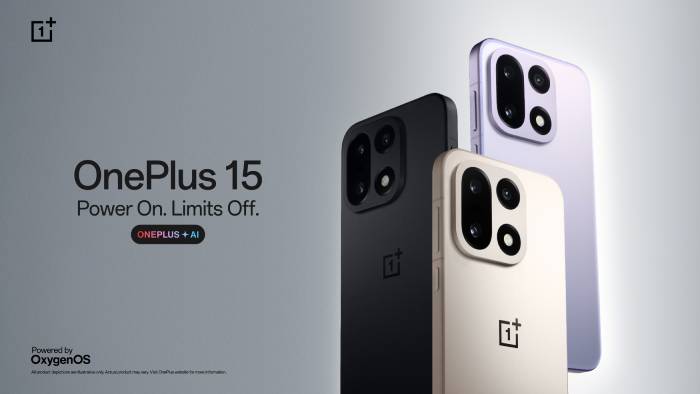
The OnePlus 15 takes first place because battery anxiety is one of the hardest problems to solve during a long event. OnePlus lists a 7,300mAh Silicon NanoStack battery, 120W SUPERVOOC wired charging and 50W AIRVOOC wireless charging. The company says a full wired charge takes around 39 minutes under its specified test conditions.[1] Those figures do not predict an exact number of GPS-active hours, but they provide a substantially larger stated energy reserve than the 4,985mAh Pixel or 5,000mAh Samsung.
That reserve matters when the handset is doing several jobs at once. A cyclist might have navigation visible, audio prompts going to Bluetooth earbuds, mobile data maintaining live tracking and the camera ready at stops. A runner may keep the screen off more often, but poor signal and frequent route checks still consume power. The OnePlus cannot eliminate the need for a power bank on every ultra-distance, cold-weather or exceptionally long outing, but it gives the most convincing paper margin of these three. Fast charging is also useful between split sessions or when a forgotten overnight charge is discovered shortly before departure.
The 6.78-inch LTPO 1.5K display can vary its refresh rate up to 165Hz.[1] The refresh-rate ceiling is mainly a smoothness and gaming specification, not proof that the phone is better at navigation. For training, the practical benefit is simply the generous area for map labels, junction information and post-session statistics. Outdoor visibility, mounting angle, rain on the touchscreen and the chosen app’s interface remain more important than 165Hz, and no controlled three-way outdoor display test was available.
Size is the price paid for that battery and screen. A third-party review lists the phone at 161.42 by 76.67 by 8.1mm and 211g.[10] Add a protective case and it becomes a substantial object in a running belt, shorts pocket or armband. Runners should use a stable vest pocket or well-fitted belt that prevents bounce rather than carrying it loose. Cyclists should check the complete phone-and-case dimensions against their mount and favour a secure, vibration-damped fitting with a retention tether.
OnePlus describes the phone as resistant to water and dust under normal use, but its own wording is deliberately cautious. Resistance may decline over time; the handset is not intended for professional diving; supported exposure is to fresh water; and water-ingress damage caused by use outside the stated conditions is not covered by warranty.[1] That makes it suitable for sensible preparation around rain and sweat, not a permanently waterproof sports device. Damaged glass, previous repairs, salt water and repeated exposure all demand extra care.
Location capability is an area where restraint is necessary. The available OnePlus UK page did not expose a model-specific GNSS constellation or dual-band specification, and it does not support claims that the OnePlus 15 has superior route accuracy or the Pixel’s documented emergency-satellite system. It can still be considered for normal app-based navigation, but buyers with a specific technical GPS requirement should obtain the final UK model specification rather than infer it from the battery-led ranking.
Long-term ownership is reasonably clear on security but less complete for major operating-system upgrades. OnePlus lists a security-update end date of 13 November 2031, while noting that its security-period information is for reference and actual details depend on updates received by the device.[2] Its UK terms provide a 24-month limited warranty for mobile devices bought through oneplus.com, in addition to statutory rights. That warranty is restricted to the original purchase country or region, and reseller purchases are directed back to the point of sale.[3]
✅ Pros:
- The largest stated battery reserve in this comparison, paired with very fast wired charging.
- Large, fluid display that gives maps, route prompts and training summaries plenty of room.
- Strong performance headroom and documented security support into late 2031.
⛔ Con:
- Its large 6.78-inch body and reported 211g weight make it the most cumbersome choice for runners.
Main standout feature: the combination of a 7,300mAh stated capacity and 120W wired charging. It offers the strongest buffer for a phone being used as route screen, tracker, communications device, music source and camera across a long training day.
Who it is best for: long-distance cyclists, event participants and runners who put battery margin above pocket comfort. It is less suitable for someone who wants the lightest, smallest phone for short runs or who prioritises a fully documented emergency-safety suite. Choosing it means accepting more bulk and less clearly documented navigation hardware in exchange for the best endurance proposition.
2. Google Pixel 11 — Best for Google safety, navigation and camera software
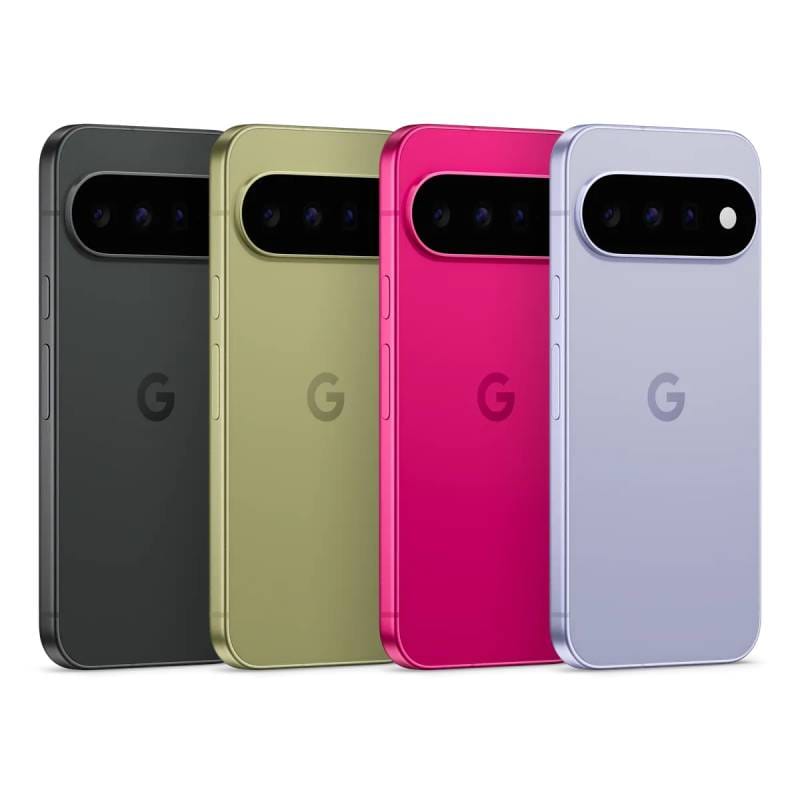
The Google Pixel 11 is the most compelling choice for a solo runner or cyclist who wants safety and navigation features to be central to the decision. Google’s official specification lists Satellite SOS, Emergency SOS, Crisis Alerts, Car Crash Detection, Safety Check, Emergency Location Service, emergency contacts and medical information, along with theft protection.[4] Neither of the other two phones has a comparably complete, model-specific safety list in the verified material.
Safety Check is particularly relevant to planned solo sessions. It can be configured around an expected check-in time, with Emergency Sharing available when a check is missed. Google’s safety tools can share information such as live location and remaining battery percentage with selected emergency contacts.[5][6] These settings need to be configured before leaving, and the relevant contacts should understand what an alert means. An unconfigured feature provides no practical reassurance in an incident.
Satellite SOS is another differentiator, but it should be treated as contingency rather than permission to take greater risks. Google states that the Pixel 11 service is available in the UK subject to restrictions and setup and is included at no additional charge for the first two years after activation. Connection and response times vary with location and site conditions. Google also warns that Personal Safety features depend on factors including connectivity and may not be reliable for emergency communications or available everywhere.[4] Offline maps, identification, suitable clothing and informing someone of the route remain essential.
The navigation hardware is the most explicitly documented in the comparison. For the rest-of-world model relevant to the UK, Google lists dual-band GNSS with GPS, GLONASS, Galileo, BeiDou, QZSS and NavIC.[4] Dual-band reception can be useful in technically challenging environments, but it is not a guarantee that every training app will produce a flawless line or timely turn prompt. App design, downloaded map data, antenna conditions, terrain and mounting position still affect the experience.
At 6.3 inches and 197g, the Pixel 11 occupies a useful middle ground.[4] It is heavier than the 179g Samsung but physically smaller than both alternatives, which can make it easier to stabilise in a running belt or jacket pocket. Cyclists still need to confirm mount compatibility with the chosen case. The smaller display sacrifices some of the OnePlus and Samsung map area, but many runners will prefer less bulk over a larger route view.
Google lists a typical 4,985mAh battery and more than 30 hours of battery life under its own test methodology. It also claims charging to 55% in around 30 minutes with a 30W USB-C PPS charger or higher.[4] These are normal-use manufacturer figures rather than continuous-navigation results. The capacity is far below the OnePlus figure and close to Samsung’s, so a remote or all-day outing warrants a conservative charging plan. The compatible wall charger is sold separately; the official box list includes a USB-C cable and SIM tool, not a mains adaptor.
Weather protection is documented as IP68, with Gorilla Glass Victus 2 on the front and back.[4] IP68 is valuable around rain and splashes, but Google says resistance can diminish through wear, repair, disassembly or damage. A fall may compromise it. Use a protective case, inspect the phone after impacts and avoid treating the rating as permanent waterproofing.
The Pixel also has the strongest documented camera and video toolkit for recording a route or taking post-run images. Google lists a 48MP wide camera, 13MP ultrawide and optically stabilised 10.8MP 5x telephoto camera, plus optical and electronic stabilisation, wind-noise reduction and 4K video.[4] That is specification-level evidence rather than a final comparative camera test, and early independent Pixel 11 coverage was primarily hands-on reporting at the research date.[11] A phone should never be handheld while riding.
✅ Pros:
- The strongest verified emergency toolkit, including Satellite SOS, Safety Check and Car Crash Detection.
- Explicitly documented dual-band, multi-constellation GNSS for the model relevant to the UK.
- Seven years of operating-system, security and Pixel Drop updates.
⛔ Con:
- Its stated battery capacity and charging speed leave less endurance margin than the OnePlus 15.
Main standout feature: the joined-up combination of dual-band GNSS and pre-ride safety tools. The value is not just the length of the feature list, but the ability to prepare emergency contacts, medical details and a scheduled check before leaving.
Who it is best for: solo runners, remote-route cyclists and buyers already invested in Google navigation and photo software. Avoid choosing it purely for endurance: the OnePlus gives a much larger stated battery reserve. The Pixel compromise is accepting less aggressive battery and charging figures to gain the clearest safety, location and long-term software package. Google lists seven years of OS, security and Pixel Drop updates and a two-year warranty in Great Britain.[4]
3. Samsung Galaxy A57 5G — Best value mainstream phone with long support
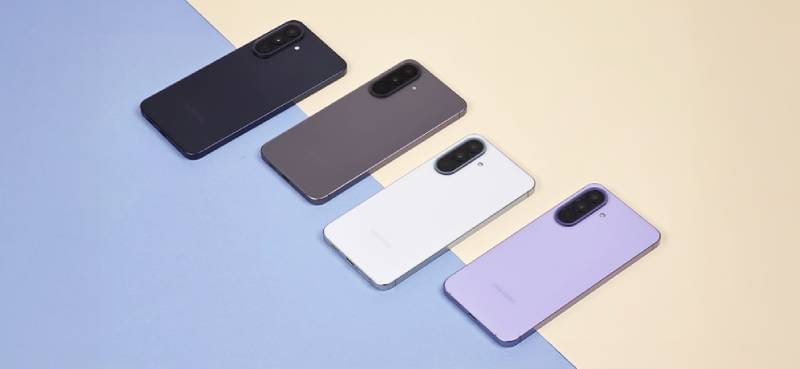
The Samsung Galaxy A57 5G is the most balanced choice for everyday running, commuting and weekend cycling when flagship extras are not worth a substantial premium. Samsung announced UK availability from 10 April 2026, with launch RRPs of £529 for the 256GB/8GB version and £699 for 512GB/12GB.[8] Those are dated launch prices, not current Amazon claims. Its value position therefore depends on the live price, but it starts from a more accessible category than a premium endurance-focused handset.
Samsung lists a 5,000mAh typical battery and claims up to two days of use under its own conditions. It also advertises Super Fast Charging 2.0 to as much as 60% in 30 minutes, with the UK power specification identifying a maximum 45W charging requirement.[7] The two-day statement should never be translated into a guaranteed number of cycling or running hours. Continuous GPS, mobile data, a bright 120Hz display, Bluetooth audio, video and cold weather can all shorten runtime significantly.
For ordinary training, however, the battery and charging specification is credible rather than bare-minimum. It sits close to the Pixel in stated capacity, while its quoted 30-minute percentage is slightly higher under Samsung’s separate test conditions. Those manufacturer tests are not directly comparable stopwatch results. Buyers should think in terms of use case: the A57 should suit everyday sessions and navigation, but the OnePlus offers more theoretical reserve for an all-day event.
The design is unusual in a helpful way. Samsung lists a 6.7-inch FHD+ Super AMOLED Plus 120Hz display, dimensions of 161.5 by 76.8 by 6.9mm and a weight of 179g.[7] It is the lightest option here, which helps in a running belt, yet it is still broad and tall. A loose shorts pocket may allow it to move uncomfortably. The large screen is better suited to map visibility than minimalist carrying, so runners should test their belt or vest pocket with a similarly sized object before committing.
For navigation, Samsung documents GPS, GLONASS, BeiDou, Galileo and QZSS support.[7] That is a useful multi-constellation specification and more explicit than the available UK OnePlus information. Samsung does not describe the A57 as dual-band GNSS, however, so it should not be assumed to match the Pixel 11’s documented implementation. For most buyers, downloading maps, testing the chosen route app and positioning the phone sensibly will matter more than collecting constellation names.
IP68 dust and water resistance adds reassurance for changeable British weather.[7] As with the Pixel, that rating is not a promise of permanent waterproofing or a reason to expose the phone unnecessarily. A case and protected carry position remain sensible, especially if the device has been dropped or repaired. Cyclists should use a mount with secure corner or case retention, and a tether provides a second layer if the primary mechanism loosens.
Samsung’s ecosystem is another practical reason to choose it. Official specifications list compatibility with a broad range of Galaxy Watches and Galaxy Buds.[7] That can simplify notifications, audio and account management for an existing Samsung owner, although it does not mean the phone replaces a watch’s onboard GPS or emergency capability. Confirm that the exact training, sensor and live-tracking apps you use support the intended phone, wearable and account configuration.
The camera system consists of a 50MP optically stabilised main camera, 12MP ultrawide and 5MP macro camera, with 4K recording at 30fps.[7] OIS and an ultrawide lens are practical for finish-line photographs, route conditions and documenting damage after an incident. The Pixel has the more complete documented video package, including higher listed frame-rate options and broader stabilisation features, so frequent activity-video creators have a reason to spend more.
Long-term support is a central value advantage. Samsung promises up to six OS upgrades and six years of security updates, with the UK specification listing a security-update period valid until 31 March 2032.[7] That can matter more than a minor hardware advantage if the phone is kept for several seasons. Continued updates do not protect against crash damage or battery ageing, but they support a longer useful software life.
✅ Pro:
- The lowest documented weight of the three, despite its large 6.7-inch screen.
- IP68 resistance and clearly documented multi-constellation location support.
- Up to six OS upgrades and six years of security updates.
⛔ Con:
- It lacks the Pixel 11’s verified Satellite SOS, Safety Check and crash-detection package.
Main standout feature: its combination of low weight, IP68 resistance, documented location support and six-year security horizon. It is not the smallest phone, but it avoids making the buyer choose between a large map screen and a particularly heavy body.
Who it is best for: casual runners, commuters, regular club riders and existing Samsung users seeking a current mainstream handset with long support. Buyers planning isolated routes should prefer the Pixel’s verified emergency tools, while all-day endurance users should consider the OnePlus battery advantage. The A57 compromise is accepting fewer specialist safety and video features in return for a more value-focused ownership proposition.
Check our website for more details about Samsung Galaxy A57 5G
What makes a great phone for running and cycling in 2026?
A useful training phone must remain dependable when several power-hungry functions operate together. Headline battery capacity matters, but so do the route, weather, carry method and charging plan. These are the criteria that explain why the three recommendations occupy different positions.
- Usable battery reserve: GPS, mobile data, screen brightness, Bluetooth audio or sensors, live sharing and video can produce a much heavier load than ordinary mixed use. Manufacturer battery claims are directional rather than promised ride or run times. The OnePlus has the largest stated reserve; the Pixel and Samsung are closer together on capacity.
- A realistic top-up plan: charging wattage alone is not enough. The fastest rate may require a compatible or separately purchased adaptor, and speed falls as the battery fills or temperature changes. Consider whether you normally charge overnight, at work, during a café stop or from a portable battery.
- Documented location hardware: multi-constellation support gives the phone access to several satellite systems. Pixel 11 goes further with an explicit dual-band specification. Hardware is only one part of navigation: app quality, offline map availability, terrain, mounting position and route preparation still determine whether prompts are useful.
- Safety that is configured in advance: emergency contacts and medical details should be added before a solo session. Pixel’s Safety Check and Satellite SOS are meaningful differentiators, but their limitations must be understood. No emergency feature guarantees coverage, a connection or a particular response time.
- Rain and impact preparation: IP68 or broader water and dust resistance is valuable around rain and sweat, but resistance can diminish. A case, protected pocket and secure bicycle mount are still important. Salt water, damaged seals and repaired housings deserve particular caution.
- Carry comfort: weight does not tell the entire story. Samsung is the lightest but has a wide 6.7-inch body; Pixel is heavier but more compact; OnePlus is both large and comparatively heavy. Runners need a non-bouncing belt, vest pocket or suitable armband. Riders need a mount compatible with the phone, case and button layout.
- Glanceable rather than distracting: a large, fluid screen can improve map readability, but peak refresh rate does not prove outdoor legibility. Font size, glare, mounting angle, gloves, rain interaction and sensible audio prompts matter more. Stop safely before carrying out detailed screen interactions.
- Support for several seasons: a training phone may outlast multiple watches, sensors and headphones. Long security support protects the ownership proposition, while a clear UK purchase and warranty route makes repairs or faults easier to address.
The best choice therefore depends on which failure would be most disruptive. If it is running out of power, OnePlus has the advantage. If it is lacking a prepared safety channel or explicit dual-band GNSS, choose Pixel. If it is paying flagship money for features you may rarely use, Samsung offers the more restrained package.
Comparison: phones for runners and cyclists UK 2026
The decisive trade-off is straightforward: OnePlus concentrates on energy reserve and rapid refilling, Pixel on safety and documented navigation hardware, and Samsung on weight, longevity and mainstream value. The specifications below are manufacturer figures gathered under different conditions, not results from one controlled head-to-head test.
| Best for | Exact model | Key specifications | Key strength | Main limitation | Typical UK buyer |
|---|---|---|---|---|---|
| Long training sessions | OnePlus 15 | 7,300mAh; 120W wired; 6.78-inch display; reported 211g | Largest stated battery and fastest headline wired charging | Bulky to carry; UK GNSS detail not verified | All-day cyclist or endurance-event participant |
| Safety and navigation software | Google Pixel 11 | 4,985mAh; dual-band GNSS; 6.3-inch display; 197g; IP68 | Verified SOS, Safety Check, crash detection and location package | Less battery margin than OnePlus | Solo runner or remote-route cyclist |
| Mainstream value and support | Samsung Galaxy A57 5G | 5,000mAh; up to 45W; 6.7-inch display; 179g; IP68 | Low weight, six OS upgrades and six years of security support | No verified Pixel-equivalent emergency suite | Casual runner, commuter or Samsung wearable owner |
OnePlus 15: Check price on Amazon UK
Google Pixel 11: Check price on Amazon UK
Samsung Galaxy A57 5G: Check price on Amazon UK
What to consider before buying
Once the preferred phone is clear, check the total ownership setup rather than comparing handset specifications in isolation.
- Plan the carry or mount first: measure the phone with its intended case, not as a bare handset. Confirm that a bicycle mount does not obstruct buttons or cameras and that it has secure retention. Runners should consider belt or vest-pocket depth, closure and bounce. A light phone that moves constantly can be less comfortable than a heavier phone held firmly.
- Budget for protection: none of these phones should be treated as an exposed sports computer. A grippy protective case and, for cycling, a retention tether are sensible costs. Weather protection around the mount or pocket may still be appropriate despite water resistance, especially during prolonged rain.
- Check the charging bundle: Pixel’s quoted rate requires a compatible 30W USB-C PPS charger or higher, sold separately. Samsung lists a cable but no mains adaptor and supports up to 45W input. The researched OnePlus material did not establish a dependable retail-box charger bundle. Verify the listing instead of assuming the headline charging rate is available out of the box.
- Test apps before an important event: download offline maps, import the route and confirm audio prompts, auto-lock behaviour, permissions and battery settings. Check compatibility with the intended watch, heart-rate sensor, earbuds and live-tracking service. A phone’s GNSS specification cannot fix an app configured incorrectly.
- Prepare safety details: add emergency contacts and medical information and rehearse the relevant shortcut. Pixel owners should configure Safety Check and understand Satellite SOS restrictions before entering a low-signal area. Owners of the other phones should not assume that generic Android software provides the same model-specific tools.
- Review subscriptions and data needs: mapping, live tracking, cloud photo storage or satellite-related services may have separate terms or future charges. Google includes Pixel 11 Satellite SOS for the first two years after activation under its stated UK conditions, so check the current service position if buying or activating later.[4]
- Consider software life: Pixel promises seven years of OS, security and Pixel Drop updates. Samsung offers up to six OS upgrades and six years of security support. OnePlus publishes a November 2031 security end date, but a separate current UK promise for a specific number of major Android upgrades was not verified. Do not invent equivalence where the published commitments differ.
- Verify the UK support route: Google lists a two-year warranty in Great Britain. OnePlus advertises a 24-month limited warranty for qualifying direct purchases and directs reseller customers to the point of sale. For any Amazon purchase, establish who handles faults and whether the exact handset variant is accepted by UK support.
- Keep proof of purchase: retain the invoice, serial information and listing details. Manufacturer warranties sit alongside applicable statutory consumer rights for faulty goods, but the practical route depends on who sold the phone and the circumstances.[9]
Want to explore these priorities in more detail? Read our guide to Phones for Navigation & GPS Use (UK 2026) for dependable picks for driving, walking and commuting, or see our Best Phones for Battery Life (UK 2026) if endurance is your biggest priority.
Frequently asked questions
Which phone is best for a very long ride, all-day event or marathon day?
The OnePlus 15 is the strongest paper choice for endurance-focused use. Its stated 7,300mAh battery is considerably larger than the Pixel 11’s 4,985mAh and the Galaxy A57 5G’s 5,000mAh capacities. OnePlus also quotes 120W wired charging, making it the easiest of the three to refill rapidly between sessions.[1][4][7]
That does not guarantee that it will last through every event. Signal strength, temperature, display brightness, navigation, Bluetooth accessories and recording can all change consumption. Its reported 211g weight and large body also make it less comfortable for running. Choose it when battery margin is more important than pocketability, and carry backup power when the consequences of an empty battery are serious.
Does the Google Pixel 11’s Satellite SOS make it safe to leave mobile coverage?
No. It is an additional contingency layer, not a substitute for preparation. Google includes the UK in the Pixel 11 Satellite SOS availability notes and states that the service is included at no extra charge for the first two years after activation. Restrictions and setup apply, while connection and response times vary by location and site conditions.[4]
Configure it before leaving, but also download offline maps, tell someone the route and expected return time, carry identification and take equipment appropriate to the weather and terrain. Google warns that Personal Safety features may depend on connectivity and other factors and may not be reliable or available in every situation.
Are these phones waterproof enough for rainy running and cycling?
Treat them as rain-resistant phones, not waterproof sports devices. Google Pixel 11 and Samsung Galaxy A57 5G have documented IP68 ratings.[4][7] OnePlus confirms water and dust resistance under normal use but warns that resistance can diminish and that non-compliant water-ingress damage is not covered by warranty.[1]
A case, covered pocket or weather-protected mount remains sensible. Be particularly cautious around salt water, damaged glass, previous repairs and repeated heavy exposure. Allow a wet charging port to dry and follow the relevant manufacturer instructions rather than forcing a cable connection.
Will I need to buy a charger separately?
Possibly, so check the exact retail bundle. Google’s quoted 55%-in-about-30-minutes performance uses a 30W USB-C PPS charger or higher, sold separately, and the official box list does not include a wall adaptor. Samsung lists a USB-C cable but no adaptor, while its maximum input is 45W.[4][7]
OnePlus advertises 120W charging, but the researched UK product page did not provide a dependable in-box charger statement. Amazon bundles can vary by seller and region. Confirm the included hardware and its UK plug before ordering, and factor a compatible charger into the total price comparison.
Final verdict
The OnePlus 15 is the strongest overall pick for long training sessions because its 7,300mAh stated battery and 120W wired charging address the most common all-day navigation concern directly. The compromise is physical: it is the largest and heaviest option, and its UK GNSS specification is less clearly documented than the Pixel’s.
- OnePlus 15 — Best overall for long training sessions: choose it for maximum stated battery margin and rapid top-ups. Check price on Amazon UK.
- Google Pixel 11 — Best for Google safety, navigation and camera software: choose it for dual-band GNSS, Safety Check, Satellite SOS and the longest stated update package. Check price on Amazon UK.
- Samsung Galaxy A57 5G — Best value mainstream phone with long support: choose it for its relatively low weight, IP68 rating, Samsung ecosystem and six-year security commitment. Check price on Amazon UK.
For an all-day ride, OnePlus is the decisive choice; for solo or remote routes, Pixel’s verified safety tools justify second place; for everyday training at a more restrained price level, Samsung is the sensible value route. Whichever model fits, test the complete phone, case, mount, route app and emergency setup before relying on it during an important outing, and verify the live Amazon seller, returns, UK warranty and accessories at checkout.
Still not sure which phone is right for your training, budget and priorities? Try the ChoiceWise AI Phone Advisor — answer a few quick questions and get personalised recommendations to help you find the best phone for you.
By ChoiceWise