Phones for Reading and E-Books (UK 2026) – Comfortable Screens for Long Reading Sessions
The best premium phones for e-books, PDFs, comics and long-form articles, compared for screen space, glare, annotation, battery expectations and hand comfort.
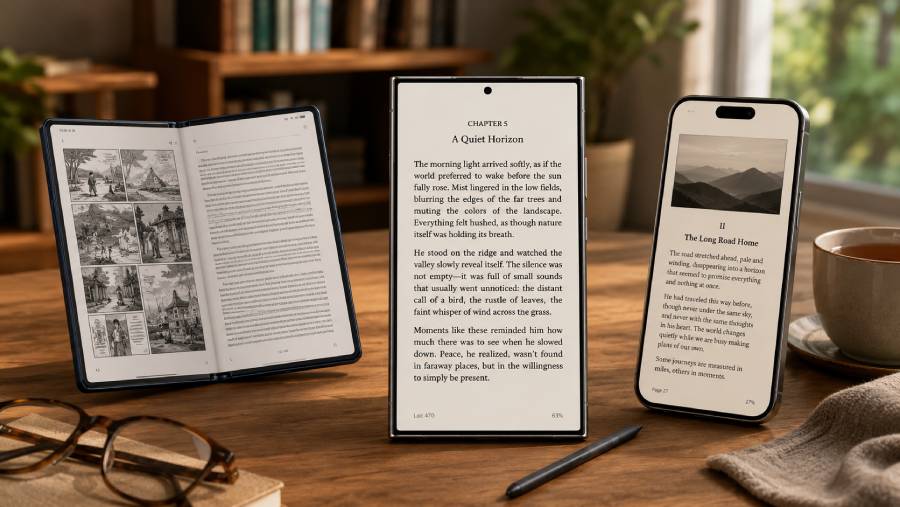
Updated for 2026 after assessing screen size and shape, glare handling, text controls, annotation, portability and realistic battery expectations.
- Samsung Galaxy Z Fold7 5G 256GB — Best large-screen phone for reading and e-books — Check price on Amazon UK
- Samsung Galaxy S26 Ultra 5G 256GB — Best overall premium phone for long reading sessions — Check price on Amazon UK
- Apple iPhone 17 Pro Max 256GB — Best iPhone for reading, battery life and premium display quality — Check price on Amazon UK
👉 Continue for the full reviews, direct trade-offs and advice on choosing the right screen format.
Introduction
This guide is for UK buyers who want one device for everyday phone duties and sustained reading—whether that means novels in Kindle or Apple Books, long articles, study documents, downloaded PDFs, comics or audiobooks. The best phones for reading and e-books are not determined by diagonal screen size alone. Display shape affects how much of a fixed page you can see, anti-reflective treatments matter in bright rooms and on trains, and a large handset can become tiring when held one-handed in bed.
The three locked 256GB models here address different priorities. Samsung’s Galaxy Z Fold7 provides an 8-inch unfolded workspace for document-heavy reading; the Galaxy S26 Ultra combines a conventional 6.9-inch screen with an anti-reflective design and built-in S Pen; and Apple’s iPhone 17 Pro Max offers a 6.9-inch OLED display, extensive text adjustments and a strong manufacturer-rated battery reserve.
These are premium multipurpose phones rather than distraction-free e-readers, so the right choice depends on how much you value phone functionality, reading-app access and annotation. Check those details on the live result before ordering.
What to consider before buying
- Start with the material you read: reflowable novels adapt easily to a conventional phone screen. Scanned books, academic papers, magazines and comics benefit much more from the Fold7’s wider, nearly square inner display because less zooming and horizontal movement are required. [1][2]
- Consider the reading environment: the S26 Ultra and iPhone 17 Pro Max have official anti-reflective display claims. On the Fold7, reviewers found that the central crease could remain visible in glare or against plain page backgrounds. [3][5][7][8]
- Check your actual text settings: font size, line spacing, colour theme and brightness can matter more than a headline refresh-rate figure. Apple provides Larger Text, Display Zoom and related contrast and display adjustments. [6]
- Decide whether handwriting matters: the S26 Ultra is the only phone here with a built-in S Pen. The Fold7 offers more document space but does not support S Pen input on this generation. [3][8]
- Think about how you hold a phone: the S26 Ultra weighs 214g and the iPhone 17 Pro Max 231g. Both provide large screens, but neither should automatically be assumed comfortable for prolonged one-handed use. [3][5]
- Interpret battery figures cautiously: Apple’s quoted endurance is based on video playback, not e-book reading. Brightness, signal quality, background apps, mobile data and audiobook playback will change real results. [5]
- Check the exact Amazon result: confirm the 256GB UK model, seller, item condition, fulfilment arrangement, applicable UK warranty, return window and included accessories before buying.
All three offer an official 256GB configuration. That is likely to be generous for text-based books, but high-resolution comics, scanned PDFs, audiobooks, offline video and a large photo library can use substantially more space.
What makes a great product in this category in 2026
- Usable page area: an 8-inch display is not automatically better than a 6.9-inch one, but the Fold7’s 2184 × 1968 inner screen is unusually close to square. That gives fixed-layout pages more width than a tall bar-phone display. It should not be described as 4:3. [1]
- Sharp, controllable text: high resolution helps fine type and detailed documents, while adaptive refresh can make scrolling feel fluid. Comfort remains personal, however, and refresh rate alone does not establish whether a display will suit a sensitive reader.
- Glare management: reflections can obscure text even when a display is bright. Anti-reflective designs are therefore relevant for daylight, cafés, bright offices and public transport, although users should still set brightness to a comfortable level rather than treating maximum output as the goal. [3][5]
- A suitable annotation workflow: accurate selection, note-taking and PDF markup matter to students and researchers. A built-in stylus is more convenient than relying only on touch input, but it is unnecessary for readers focused on novels and articles.
- Practical endurance: a large battery reserve is useful for travel, reading and audiobook days, but no manufacturer figure here promises a fixed number of reading hours. App choice, wireless conditions and screen brightness affect consumption.
- Manageable handling: a larger screen can reduce scrolling while increasing hand strain. The ideal balance differs between reading at a desk, standing on a train and holding a phone above your face in bed.
The central decision is therefore not which phone has the largest number on its specification sheet. It is whether you need a tablet-like page, a conventional Android phone with pen input, or an iPhone with strong accessibility controls. The reviews below apply those distinctions to everyday ownership rather than treating all large OLED displays as interchangeable.
Top 3 products worth buying – UK 2026
1. Samsung Galaxy Z Fold7 5G 256GB — Best large-screen phone for reading and e-books
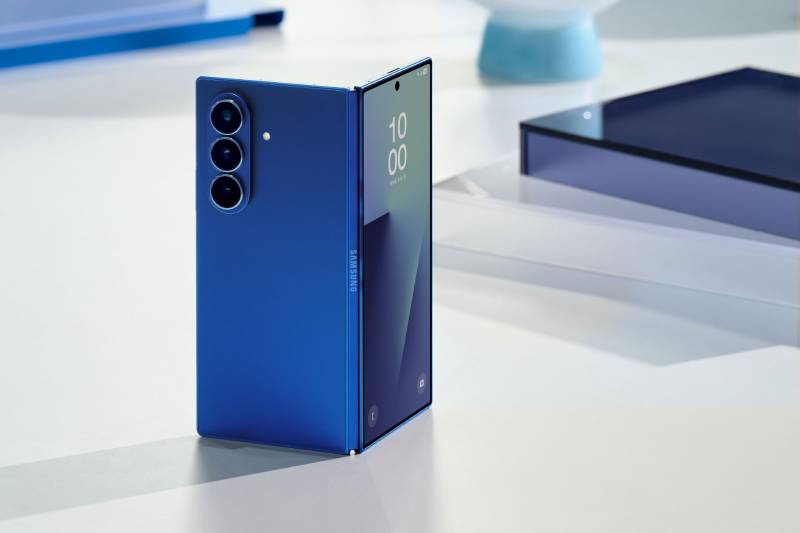
Positioning: the strongest choice when full-page documents, comics and side-by-side reference work matter more than the simplicity of a conventional phone.
The Galaxy Z Fold7’s defining feature is its 8-inch Dynamic AMOLED 2X inner display. Samsung specifies a resolution of 2184 × 1968 and an adaptive 1–120Hz refresh rate, while the outside cover display measures 6.5 inches. The inner panel is much closer to square than an ordinary phone screen, giving PDFs, magazines, manga and technical documents more usable width. It is not a 4:3 display, but it is still the closest option in this shortlist to carrying a small tablet that folds into a handset. [1][2]
That shape changes the reading experience more meaningfully than a modest increase in diagonal size. A reflowable novel will work well on any of these phones, but a scanned page or complex PDF often requires repeated zooming on a tall 6.9-inch screen. The Fold7 can show more of the original page while keeping text at a practical size. Samsung also positions the wider display for multitasking, making it the best fit here for placing a document beside a browser, dictionary, messages or reference notes. [2]
The compromise is that the main benefit only appears after unfolding the device. For quick reading while standing or walking, the 6.5-inch cover screen behaves more like a conventional phone. Opening the Fold7 makes most sense when seated on a train, reading at a desk or settling in for a longer session. Buyers are also accepting a hinge, two displays and the additional ownership complexity of a foldable rather than a simple single-screen design.
Screen continuity deserves particular attention. Editorial reviewers found the central crease much less prominent than on some earlier foldables, but it could still be visible in glare or against the plain, solid-colour background of a book page. Readers who are easily distracted by lines or reflections should inspect the phone in person rather than assuming the crease will disappear in every environment. [7][8]
There is also no S Pen support on this generation. That prevents the Fold7 from fully capitalising on its large canvas for handwritten marginal notes, so the S26 Ultra is the more coherent choice when stylus annotation is central to the purchase. [8]
Pros
- Largest and most document-friendly reading surface in this three-phone comparison.
- Nearly square inner display reduces zooming on many PDFs, comics and scanned pages.
- Strong layout for reading beside a browser, dictionary or notes app.
Cons
- The foldable design adds cost and complexity, while the visible crease and lack of S Pen support may frustrate readers expecting a seamless digital-notebook experience.
Main standout feature: the 8-inch inner display is the only screen here that materially changes fixed-page reading rather than simply enlarging a conventional phone layout. It is the clearest functional upgrade for PDF-heavy users. [1]
Who it is best for: commuters, researchers and comic or manga readers who want to carry one device instead of both a phone and small tablet. Avoid it if you mainly read reflowable novels, dislike foldable mechanisms or need handwritten PDF annotation.
2. Samsung Galaxy S26 Ultra 5G 256GB — Best overall premium phone for long reading sessions
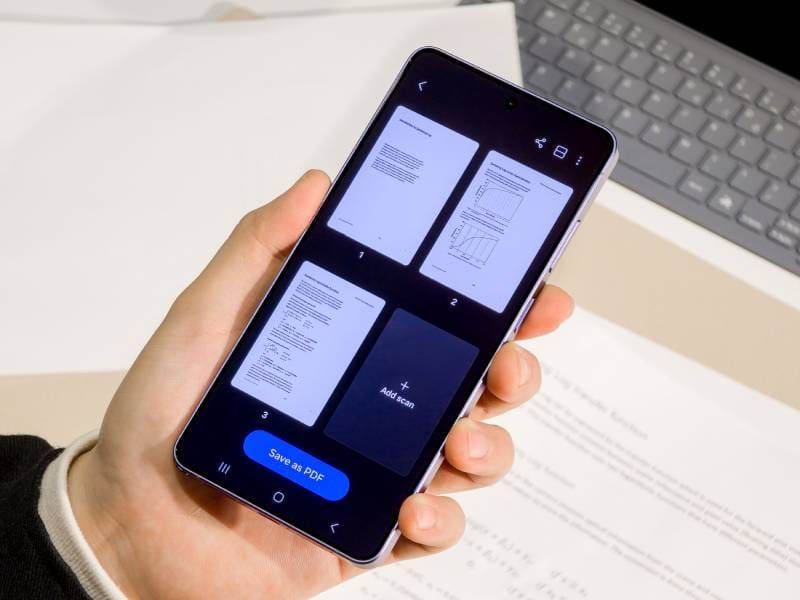
Positioning: the most complete conventional Android option for readers who want a large anti-reflective screen and integrated document annotation without a foldable hinge.
The Galaxy S26 Ultra is the balanced recommendation in this group. Samsung lists a 6.9-inch QHD+ Dynamic AMOLED 2X display with an adaptive 1–120Hz refresh rate, giving books and articles a large, sharp canvas while retaining a familiar single-screen design. Its official anti-reflective treatment is particularly relevant for reading beside windows, under bright office lighting or on public transport, where reflections can be more disruptive than a small difference in resolution. [3][4]
This is still a very large handset. Samsung lists it at 214g and 7.9mm thick, so its generous page area should not be confused with effortless one-handed comfort. It suits two-handed reading or resting the phone against a surface better than extended use with one hand. The advantage over the Fold7 is predictability: there is no need to open it, no centre crease passing through a page and no change between cover-screen and inner-screen layouts. [3]
The built-in S Pen is the S26 Ultra’s most useful reading-specific extra. It can support precise text selection, handwritten notes and PDF markup without requiring a separate optional pen to be carried. That makes this the most practical option for students, researchers, reviewers and professionals who interact with documents instead of only consuming them. Samsung confirms that the pen is integrated into the handset. [3]
Samsung also specifies a 5,000mAh battery, but capacity alone does not guarantee a particular number of reading hours. Brightness, mobile signal, background services and audiobook playback all influence endurance. The sensible conclusion is that it belongs to a large-battery flagship class, not that it will meet an invented e-book runtime. [3]
Privacy Display may appeal to commuters reading personal or work material. It should be treated as an optional public-space tool rather than the best everyday display mode: an editorial review found that activating it reduced brightness and effective resolution. The same review found the anti-reflective glass visibly useful, while also discussing mixed reports about text clarity and eye comfort. Display-sensitive buyers should inspect the phone and use the retailer’s applicable returns process if it does not suit them. [9]
Pros
- Large 6.9-inch QHD+ screen with an official anti-reflective design.
- Built-in S Pen is ideal for notes, accurate selection and PDF markup.
- Conventional single-screen format avoids a hinge, unfolding routine and centre crease.
Cons
- Its premium price and 214g build make it a substantial phone, particularly for readers who prefer prolonged one-handed or bedtime use.
Main standout feature: no other model here combines a conventional 6.9-inch anti-reflective display with a stylus stored inside the phone. That pairing makes it more versatile than its screen size alone suggests. [3]
Who it is best for: Android users who read for long periods, annotate documents or want a premium phone that does not need to be unfolded. Readers can review the full specifications on the ChoiceWise Galaxy S26 Ultra product page.
3. Apple iPhone 17 Pro Max 256GB — Best iPhone for reading, battery life and premium display quality
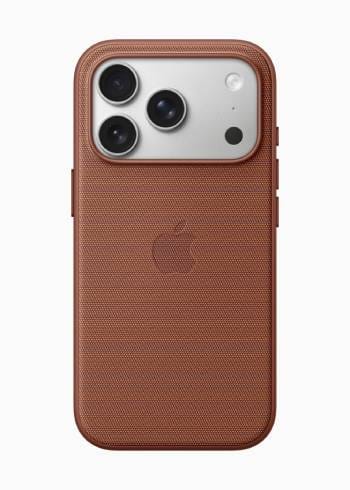
Positioning: the natural premium choice for committed iPhone users who want Apple’s largest reading canvas, extensive text controls and a substantial quoted battery reserve.
Apple specifies a 6.9-inch Super Retina XDR OLED display at 2868 × 1320 and 460ppi. ProMotion provides adaptive refresh rates up to 120Hz, while the display also has an anti-reflective coating and a quoted peak outdoor brightness of 3,000 nits. Those specifications make it a strong platform for books, articles and detailed web pages, particularly when moving between indoor and outdoor environments. An Expert Reviews assessment also judged the display strong overall. [5][10]
For actual reading comfort, Apple’s software controls are at least as important as the panel specification. iPhone settings include Larger Text, larger accessibility text sizes, Display Zoom, contrast adjustments and other display options. These can make menus and supported content easier to read, although the exact appearance of a book still depends on the reading app’s own font, spacing, theme and layout controls. [6]
The iPhone 17 Pro Max is a conventional tall phone rather than a folding document viewer. It is well suited to reflowable novels, articles and scrolling through research, but its 6.9-inch screen cannot show a full PDF page or comic panel as naturally as the Fold7’s broader 8-inch inner display. It also has no equivalent to the S26 Ultra’s built-in S Pen. The decision is therefore primarily about iOS integration and display quality rather than achieving the largest possible workspace.
Apple quotes up to 37 hours of video playback and up to 33 hours of streamed video playback. These figures indicate a substantial battery class for travel and mixed media use, but they are not e-book endurance measurements and should never be converted into a promised number of reading hours. Screen brightness, mobile reception, background activity, reading software and audiobook use will all affect the result. [5]
Physical comfort is the main reservation. Apple lists the phone at 231g, making it heavier than the 214g S26 Ultra. That mass may be manageable when using two hands or supporting the handset, but buyers who read one-handed in bed or while standing should try the size before committing. A case will also change the way the device feels, although no particular case weight or design should be assumed. [3][5]
Pros
- Sharp 6.9-inch OLED display with adaptive refresh and an anti-reflective coating.
- Extensive Larger Text, Display Zoom, contrast and accessibility settings.
- Strong manufacturer-rated battery reserve for travel and mixed media use.
Cons
- At 231g, it can become tiring during prolonged one-handed reading and still provides less fixed-page space than the unfolded Galaxy Z Fold7.
Main standout feature: the combination of a 460ppi display and Apple’s broad text and display adjustments makes it the most coherent reading choice for buyers already invested in iOS. [5][6]
Who it is best for: iPhone users who want a large premium display and adaptable text presentation without moving to Android. More technical detail is available on the ChoiceWise iPhone 17 Pro Max product page.
Comparison table: phones for reading and e-books
| Best for | Exact model | Key specifications | Key strength | Main limitation | Typical UK buyer |
|---|---|---|---|---|---|
| PDFs, comics and maximum page area | Samsung Galaxy Z Fold7 5G 256GB | 8-inch 2184 × 1968 inner Dynamic AMOLED 2X display; adaptive 1–120Hz; 6.5-inch cover display [1][2] | Broad, nearly square inner screen reduces zooming and suits side-by-side work | Foldable complexity, visible crease in some conditions and no S Pen support [7][8] | Document-heavy commuter or reader replacing some small-tablet use |
| Long sessions and handwritten annotation | Samsung Galaxy S26 Ultra 5G 256GB | 6.9-inch QHD+ Dynamic AMOLED 2X; adaptive 1–120Hz; anti-reflective display; built-in S Pen; 5,000mAh battery [3][4] | Best balance of conventional-phone simplicity, glare control and pen input | Large 214g body; Privacy Display reduces brightness and effective resolution when enabled [3][9] | Android reader, student or professional marking up PDFs |
| Premium reading within iOS | Apple iPhone 17 Pro Max 256GB | 6.9-inch 2868 × 1320 OLED at 460ppi; ProMotion up to 120Hz; anti-reflective coating; up to 37 hours quoted video playback [5] | Sharp display plus extensive text, zoom and accessibility controls | 231g weight and no folding workspace or built-in stylus [5] | Established iPhone user prioritising display quality and Apple settings |
Samsung Galaxy Z Fold7 5G 256GB: 👉 Check price on Amazon UK
Samsung Galaxy S26 Ultra 5G 256GB: 👉 Check price on Amazon UK
Apple iPhone 17 Pro Max 256GB: 👉 Check price on Amazon UK
Frequently asked questions
Which is the best phone for reading e-books and PDFs in the UK?
The Galaxy Z Fold7 is the strongest option for PDF-heavy reading because its 8-inch, 2184 × 1968 inner display offers substantially more usable page space than either conventional 6.9-inch phone. It is especially useful for comics, manga, scanned documents and placing reference material beside another app. Choose it only if that extra space justifies the folding mechanism, visible crease in some conditions and lack of S Pen support.
Is the Galaxy S26 Ultra better than the Fold7 for reading?
It is better for readers who want a normal single-screen phone or need handwritten annotation. The S26 Ultra has a 6.9-inch QHD+ anti-reflective display, adaptive 1–120Hz refresh, a 5,000mAh battery and built-in S Pen. The Fold7 remains better for full-page layouts and split-screen reading. Privacy Display on the S26 Ultra is useful for confidential material in public, but it is best left off when maximum brightness and clarity are wanted.
Is the iPhone 17 Pro Max good for long reading sessions?
Yes, particularly for readers already using iOS. It combines a 6.9-inch 460ppi OLED display, ProMotion up to 120Hz, an anti-reflective coating and controls including Larger Text and Display Zoom. Apple’s up-to-37-hour video-playback claim indicates a substantial battery reserve, but it is not an e-book runtime estimate. Its 231g weight is the main ergonomic concern.
Do I need 256GB for e-books and audiobooks?
For many readers, 256GB is generous because ordinary text-based e-books are relatively small. Storage needs rise if the same phone holds large scanned PDFs, high-resolution comics, magazines, downloaded audiobooks, offline video and extensive photo libraries. All three models have an official 256GB configuration, so display format, operating system and annotation needs are likely to be more decisive.
Final verdict
As the short answer above suggested, the Galaxy S26 Ultra is the most balanced recommendation, while the Fold7 wins when page area is the overriding priority.
- Galaxy Z Fold7 5G 256GB: best for PDFs, comics and split-screen reference reading — 👉 Check price on Amazon UK
- Galaxy S26 Ultra 5G 256GB: best overall premium phone for long sessions and S Pen annotation — 👉 Check price on Amazon UK
- iPhone 17 Pro Max 256GB: best for iOS readers wanting a sharp display, text controls and strong quoted endurance — 👉 Check price on Amazon UK
If you're still not sure which phone to buy, try our AI Wizard at:
choicewise.app/chat
It will help you to make a choice.
For most UK buyers, choose by reading format first and ecosystem second. Check the exact live listing, seller, condition, fulfilment, applicable UK warranty and returns before completing the purchase.
By ChoiceWise