Best NAS Drives for Home Users (UK 2026) – Private Photo Backup, Family Storage & Your Own Personal Cloud
A practical UK guide to choosing between compact two-bay storage, a flexible four-bay family NAS and a faster multi-gig private-cloud server.
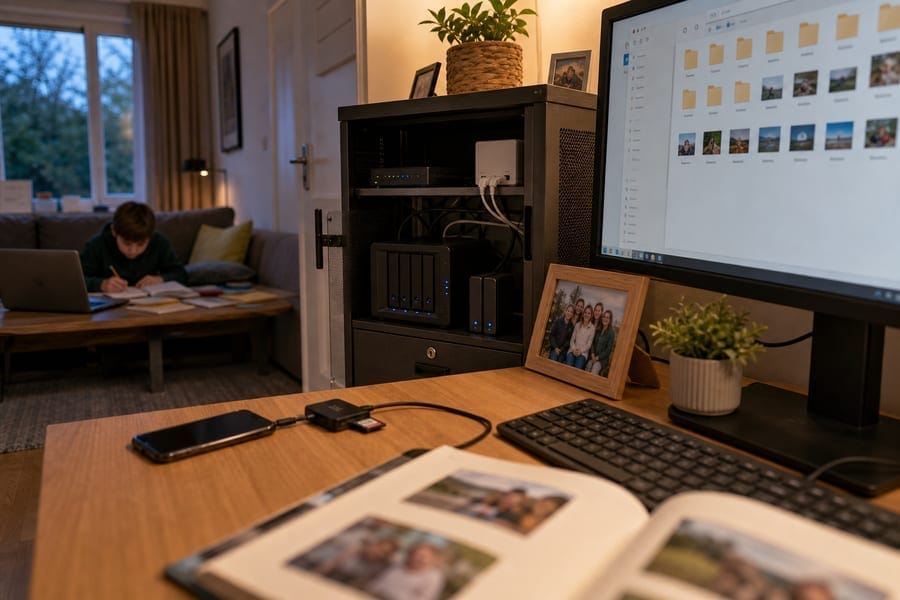
A couple protecting phone photos, a growing family centralising laptops and shared documents, and an enthusiast moving large video files need different NAS hardware. Updated for UK buyers in 2026, the Synology DS925neo+ is the strongest all-round family choice because its four bays provide a better capacity-growth path, while the smaller DS725neo+ is easier to accommodate and the TerraMaster F4-425 Pro offers the most ambitious networking.
1. Synology DS725neo+ — Compact premium option for personal photo backup and private cloud use — Check price on Amazon UK
2. Synology DS925neo+ — Best-balanced four-bay Synology option for family storage — Check price on Amazon UK
3. TerraMaster F4-425 Pro — Performance-focused four-bay private-cloud alternative — Check price on Amazon UK
👉 Continue for the important differences in bay count, usable capacity, backup software, network speed, drive compatibility and total ownership cost.
Introduction
The best NAS drives for home users can replace a patchwork of nearly full phones, unlabelled USB drives and separate household cloud accounts with one centrally managed storage system. A home NAS can receive phone-photo uploads, hold shared family folders, back up computers and make selected files available remotely. It can also keep the data physically under your control rather than making a public-cloud subscription the only home for irreplaceable photographs.
There is an important terminology point before comparing products. UK shoppers commonly search for “NAS drives”, but all three recommendations here are NAS enclosures. The official material does not establish that the supplied Amazon search results include hard disks or SSDs. You may therefore need to buy compatible storage separately, install it, create a storage pool and choose a redundancy arrangement. The meaningful price is the cost of the enclosure, drives, backup destination and any network upgrades—not the empty chassis alone.
The three options address distinct households. Synology’s DS725neo+ is the compact two-bay route for a couple or smaller household that expects a mirrored pair of disks to remain sufficient. The DS925neo+ adds four bays, stronger processing hardware and a more flexible route to expanding a large family archive. TerraMaster’s F4-425 Pro is aimed at a more technically confident owner who can exploit dual 5GbE networking, multiple NVMe slots, media capabilities and container support.
The recommendations use official manufacturer specifications and support documentation, plus UK government and National Cyber Security Centre guidance where relevant. They are practical interpretations of documented features rather than results from a ChoiceWise laboratory test. Manufacturer performance figures were produced under different conditions and should not be read as a controlled head-to-head benchmark.
UK timing also needs care. Synology announced both neo+ models on 5 August 2026 and said European availability was planned from early Q4 2026. That announcement did not itself prove live UK retail stock on the 3 September 2026 research date. [1] The Amazon URLs in this guide were manually selected search links, not live evidence of price, stock, seller identity, fulfilment, included drives or warranty coverage. Check those details on the exact listing before ordering.
Top 3 products worth buying – UK 2026
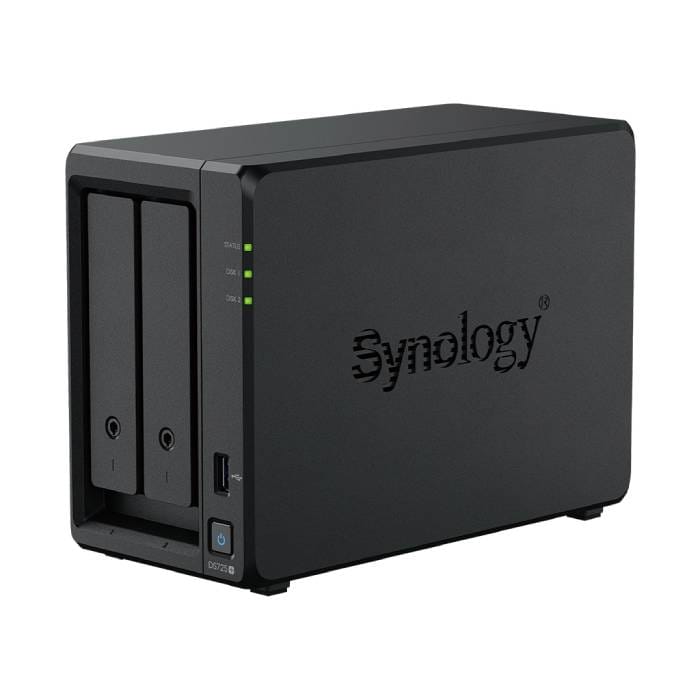
1. Synology DS725neo+ — Best compact NAS for private photo backup
✅ Pros:
- Compact two-bay enclosure with a straightforward route to mirrored household storage.
- Synology Photos and Drive provide clearly documented phone and computer backup workflows.
- Includes both 2.5GbE and 1GbE network connections, plus two NVMe cache slots.
⛔ Con:
- Two main drive bays limit capacity efficiency and future growth compared with either four-bay option.
The Synology DS725neo+ is the most appropriate choice when physical size, manageable administration and dependable everyday backup software matter more than maximum expansion. At 166 × 106 × 223mm and 1.51kg before disks, it is substantially narrower and lighter than the four-bay models. [2] It is easier to place beside a router or on a study shelf, although it still needs ventilation, a stable surface and access to power and Ethernet.
Inside is an AMD Ryzen R1600 processor with two cores and four threads. Synology lists 4GB of non-ECC DDR4 SODIMM memory as standard, two memory slots and a maximum supported capacity of 32GB. [2] That is adequate paper specification for a photo archive, file sharing and normal computer backups, with a route to increasing memory if future workloads justify it. It should not be bought on the assumption that it is a miniature high-end virtualisation server, however. The DS925neo+ has the stronger processor, while the TerraMaster configurations begin with more installed memory.
The two main bays accept 3.5-inch SATA hard disks or 2.5-inch SATA SSDs. For a first family photo system, the clearest configuration is often two matching drives using RAID 1 or Synology Hybrid RAID. If one disk fails in that arrangement, the remaining disk can preserve availability while the failed drive is replaced. The trade-off is capacity: a two-drive mirror provides roughly the usable capacity of one drive rather than the sum of both. File-system overhead reduces the final figure further.
That makes storage forecasting especially important. If the household already has several terabytes of photographs, laptop backups and 4K phone videos, buying disks that only cover today’s files can force an early and inconvenient upgrade. Growth usually means replacing the installed disks with larger models or purchasing Synology’s separately sold DX525 expansion unit. The DS725neo+ can reach seven total bays with that enclosure, but expansion adds cost and complexity. In the base two-bay chassis, RAID 5, RAID 6 and RAID 10 are not available. [2]
Networking is more capable than a basic gigabit-only backup box. There is one 2.5GbE port and one 1GbE port, while Synology quotes up to 276MB/s sequential reading and 224MB/s sequential writing under its own test conditions. [2] A wired desktop with a suitable adapter and a compatible router or switch may benefit from 2.5GbE when moving large folders. A phone uploading over ordinary Wi-Fi will not automatically achieve multi-gigabit performance, and the selected disks, RAID activity and client hardware can all become bottlenecks.
The practical reason to buy this model is DSM and Synology’s associated applications. Synology Photos supports automatic mobile photo and video backup, albums, sharing and compatible facial and object recognition features. [2] [4] Synology Drive provides synchronisation and scheduled or real-time backup routes for supported client computers. [5] Initial phone-library uploads may require the mobile application to remain active or use its focused-backup mode because mobile operating systems limit background activity. [6] This is still a much more coherent household workflow than expecting every family member to copy folders manually.
Two M.2 2280 NVMe slots are listed for cache. They should not be treated as an assumed general-purpose storage tier: unlike the DS925neo+, the DS725neo+ page describes these as cache slots. Synology also states that M.2 storage-pool creation requires verified SSDs where that function is supported. Check the current exact-model compatibility list before purchasing hard drives, memory or NVMe devices rather than applying a general rule from another DiskStation generation.
Noise depends heavily on the installed disks. The compact enclosure may fit easily in a living area, but mechanical NAS hard drives produce vibration and audible seeking during indexing, backup or array maintenance. A cupboard without ventilation is not a good solution. A study, utility area or ventilated network shelf away from beds is more realistic.
The official specification presents a three-year hardware warranty, potentially extendable to five years through eligible products, and lists UKCA certification. [2] That does not establish the warranty route for a particular Amazon marketplace seller. The documented package lists the NAS, power equipment, accessory pack and Ethernet cables but not hard drives, so inspect the precise listing contents and retain the seller invoice.
Main standout feature: the DS725neo+ combines a genuinely compact enclosure with Synology’s documented photo and computer-backup ecosystem. It is a sensible way to move a modest household away from isolated USB drives without committing space and money to four main drive bays.
Who it is best for: couples, smaller families and first-time NAS owners who expect two suitably sized drives in a mirror to cover several years of growth. Buyers with a rapidly expanding video archive, a desire for RAID 5 in the base chassis or several demanding simultaneous users should choose a four-bay model instead. The compromise is accepting lower capacity efficiency and a narrower expansion path in return for compact placement and simpler storage planning.
2. Synology DS925neo+ — Best-balanced four-bay family NAS
✅ Pros:
- Four bays provide more useful capacity-planning and RAID flexibility than a two-bay mirror.
- Dual 2.5GbE connections offer extra headroom for simultaneous household backups and file access.
- Combines Synology’s approachable photo ecosystem with NVMe cache or supported storage-pool options.
⛔ Con:
- The four-bay system requires more space and can become expensive once several compatible hard drives are added.
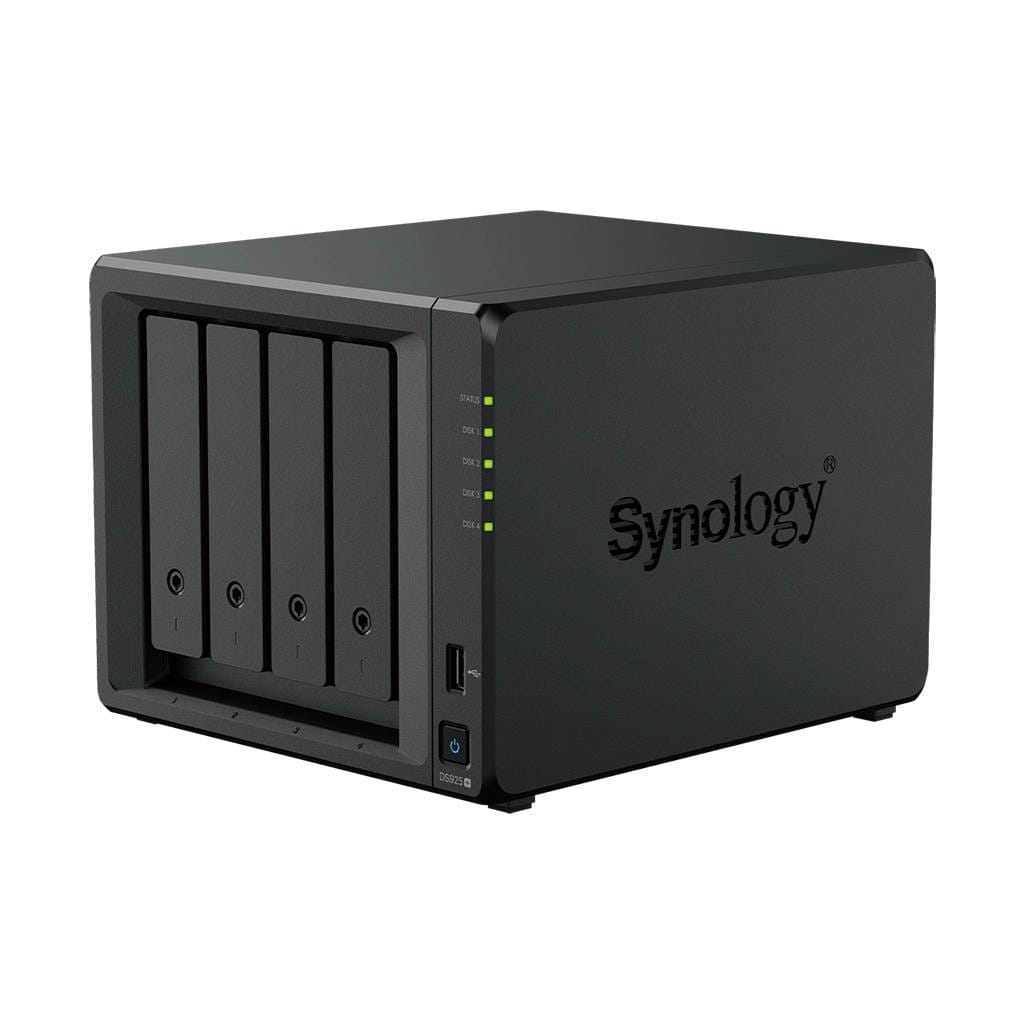
The Synology DS925neo+ is the strongest all-round recommendation for a growing family archive. It offers the same broad DSM, Synology Photos and Synology Drive proposition as the smaller model, but four main bays make it substantially easier to balance usable capacity, drive-failure resilience and future growth. That distinction is more important for most households than a small processor benchmark difference.
Synology specifies an AMD Ryzen V1500B with four cores and eight threads, 4GB of non-ECC DDR4 SODIMM memory, two memory slots and support for up to 32GB. [3] The processor provides greater service headroom than the two-core DS725neo+, which is useful when several family members browse photographs while a computer backup or indexing task runs. The standard 4GB memory remains a deliberately accessible configuration rather than a promise that heavy virtual machines, numerous containers and intensive indexing will all run without constraint. Memory expansion may be worthwhile for advanced uses, subject to current compatibility requirements.
Four 3.5-inch SATA HDD or 2.5-inch SATA SSD bays are the central advantage. The model supports Synology Hybrid RAID, Basic, JBOD, RAID 0, RAID 1, RAID 5, RAID 6 and RAID 10. Synology also documents certain migrations, including Basic to RAID 1 or RAID 5 and RAID 1 to RAID 5. [3] This gives a household more scope to change its storage plan than a fixed two-drive mirror.
For example, a sufficiently populated RAID 5 arrangement can tolerate one disk failure while retaining a greater proportion of total raw capacity than a two-drive RAID 1 mirror. It does not make every configuration equally sensible, and rebuilding a large array takes time and stresses the remaining disks. RAID 6 trades more capacity for protection against two disk failures, while RAID 10 has different performance and resilience characteristics. Buyers who do not want to administer these choices can use Synology Hybrid RAID, but should still understand the resulting usable capacity and replacement procedure before entrusting the system with family history.
Synology lists up to 96TB of raw internal capacity when using four 24TB drives, and up to 216TB raw with the separately sold DX525 expansion unit. [3] Those are maximum raw totals, not promises of usable space. Redundancy, formatting, file-system metadata, snapshots and reserved capacity all reduce what appears to users. The model can expand to nine bays with the DX525, but choosing four appropriately sized internal drives at the outset may be simpler than planning around an external expansion chassis.
Two 2.5GbE Ethernet ports provide more networking headroom than the DS725neo+ arrangement. Synology quotes up to 522MB/s sequential reading and 565MB/s sequential writing under its own conditions. [3] These figures are not directly comparable with TerraMaster’s marketing or a home Wi-Fi test. To see a meaningful benefit, the NAS, switch or router and client must all support the intended multi-gig connection. Drive count, RAID type and workload also matter. Nevertheless, dual 2.5GbE is a useful foundation when one desktop is transferring a large photo library while other users stream media or access shared folders.
There are also two M.2 2280 NVMe slots. Unlike the smaller model, Synology explicitly describes these as supporting cache or storage pools. [3] That can add flexibility for workloads involving many small files or a deliberately designed fast storage tier. Synology states that M.2 storage-pool creation requires verified SSDs, so an inexpensive NVMe drive found in an Amazon search result should not be assumed compatible. Check the live DS925neo+ list before allocating the upgrade budget.
Family-facing software remains a major advantage. Synology Photos can automatically upload phone photos and videos and provides timeline, album and controlled-sharing functions, while the model supports facial and object recognition. [3] [4] Synology Drive can back up and synchronise compatible computer folders. [5] Separate user accounts and carefully designed permissions let adults keep private folders while maintaining a shared family area. These capabilities require setup and occasional administration, but they provide a clearer route to adoption than a generic network folder that relatives may forget to use.
The chassis measures 166 × 199 × 223mm and weighs 2.26kg before drives. [3] It needs a permanent, ventilated location and becomes appreciably heavier with four mechanical disks. More drives also mean more potential seek noise, vibration and heat. This is better treated as household infrastructure than a device to place beside a television simply because that is where the router happens to be.
The official specification presents a three-year hardware warranty, potentially extendable to five years in eligible regions. [3] As with the smaller Synology, that wording does not confirm which party handles an Amazon UK claim. Official European availability was announced for early Q4 2026, so buyers should verify actual UK stock, seller identity, UK plug, included components and support route live.
Main standout feature: four-bay flexibility combined with Synology’s established family-backup workflow. It provides a better route from today’s photo library to a much larger archive without forcing the household to abandon the same phone and desktop applications.
Who it is best for: families with several phones and computers, substantial annual photo or video growth, or a preference for RAID 5-style capacity efficiency. It is less compelling for a couple with a small archive and no realistic need beyond two large mirrored drives. Choosing it means accepting a larger enclosure and higher fully populated cost in exchange for the best long-term balance in this shortlist.
3. TerraMaster F4-425 Pro — Best performance-focused private cloud
✅ Pros:
- Dual 5GbE ports give it the most ambitious wired-network specification in the shortlist.
- Four SATA bays, three NVMe slots and extensive USB connectivity support broader home-server uses.
- Hardware 4K transcoding and TOS 7 features suit media serving, synchronisation and containers.
⛔ Con:
- Its advanced hardware is easiest to justify for a technically confident buyer with a compatible multi-gig network.
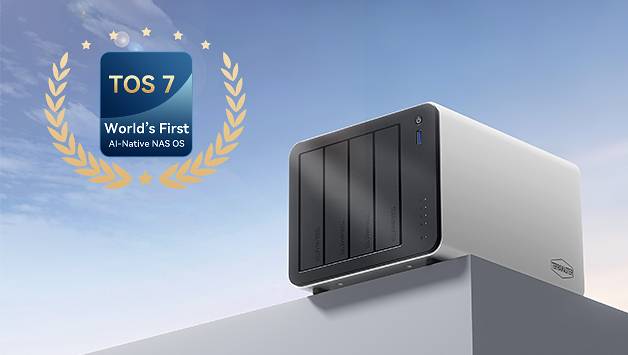
The TerraMaster F4-425 Pro is the specialist choice for a household that wants more than an uncomplicated backup appliance. TerraMaster launched it on 23 June 2026 as a four-bay system for home backup, file sharing and private-cloud storage running TOS 7. [7] Its combination of dual 5GbE, three M.2 slots, numerous high-speed USB connections and media hardware is markedly more ambitious than either Synology on paper.
The exact processor and memory variant is crucial. TerraMaster lists configurations using either an Intel N350 processor with 16GB pre-installed memory or an N305 with 8GB. Both use non-ECC SODIMM memory, have one SODIMM slot and support a stated maximum of 32GB. [8] An Amazon listing that says only “F4-425 Pro” does not establish which version is supplied. Anyone expecting the headline 16GB configuration must verify that the exact product is the N350 version rather than assuming every unit has identical internal hardware.
Four hot-swappable SATA bays accept 3.5-inch or 2.5-inch drives. TerraMaster lists Btrfs and EXT4 internal file-system support and a maximum 120TB raw internal capacity using four 30TB disks. [8] As with Synology’s figures, raw capacity is not usable capacity. The selected RAID arrangement and file system reduce the available total. The practical value is not reaching the maximum possible number; it is having four bays with which to combine resilience and useful household capacity more efficiently than a two-drive mirror.
The network hardware is the clearest differentiator. Two 5GbE RJ-45 ports provide twice the nominal per-port rate of 2.5GbE and considerably more than standard gigabit Ethernet. [8] That can matter when several suitable wired clients move large RAW photo libraries, video projects or backup images through a compatible multi-gig switch. It can also provide room for a more advanced network design than the typical entry-level home NAS.
It will not make every home transfer five times faster. A gigabit router, Wi-Fi-only computer, ordinary phone, slow mechanical disks or congested network can impose a much lower limit. Even with compatible 5GbE hardware, the workload and RAID arrangement affect throughput. Buyers may need to add a multi-gig switch, network adapters and appropriate cabling to realise the advantage. If the NAS will connect to a gigabit router and mostly receive phone photos over Wi-Fi, the extra network specification may produce little visible benefit.
Expansion connectivity is unusually broad. The official specification lists three M.2 2280 NVMe PCIe 3.0 ×1 slots, three USB 3.2 Type-A 10Gbps ports, one USB 3.2 Type-C 10Gbps port and HDMI output. [8] The NVMe slots can support a more deliberate performance or storage design, while the USB ports provide scope for fast local backup devices. These features add value for an owner who knows how they fit into the overall plan; they should not become a reason to purchase SSDs and peripherals without first confirming compatibility and intended use.
TerraMaster also lists a hardware transcoding engine for H.264, H.265, MPEG-4 and VC-1 video up to 4K/60fps. [8] That makes the system attractive as a private media server alongside photo and file storage. Transcoding support does not guarantee that every file, client application or streaming workflow will behave identically, and software support remains part of the equation. It is nevertheless a more explicitly media-focused specification than the Synology choices in this guide.
TOS 7 is marketed with TerraSync across NAS, PC, Mac and mobile devices, private-cloud access, cloud synchronisation and container or Docker support. [7] [8] That breadth can turn the F4-425 Pro into a flexible home server for a technically interested owner. The evidence available for this newly launched exact model is primarily TerraMaster’s own material, however, rather than extensive long-term independent ownership reporting. Advanced workflow, AI and security statements should therefore be treated as vendor claims, not ChoiceWise-tested outcomes.
Ease of use is the practical dividing line. A household prepared to learn storage pools, permissions, update management, remote access, containers and multi-gig networking can make good use of the hardware. Someone who mainly wants grandparents’ phone photos to upload with the least possible administration may find Synology’s more explicitly documented Photos and Drive pathway easier to evaluate.
TerraMaster gives a controlled standby-noise figure of 20.9dB(A), measured at one metre in its specified environment using four drives. [8] That is not evidence of near-silent operation during backups, indexing, transcoding or RAID rebuilding. Four mechanical disks can remain clearly audible in a quiet living room, so placement still needs thought.
The official TerraMaster store page displays a two-year warranty and 30-day returns wording for its own sales channel. [8] It does not prove that the same route applies to a UK marketplace purchase. Verify the actual seller, fulfilment, VAT invoice, returns terms and UK manufacturer-support process before ordering.
Main standout feature: dual 5GbE networking combined with three NVMe slots and four high-speed USB ports. No other locked option offers the same hardware foundation for a multi-gig home lab, large media library and private-cloud system in one four-bay enclosure.
Who it is best for: enthusiasts, creators and technically confident families with several wired devices or a deliberate plan to upgrade their network. Buyers using only gigabit Ethernet and ordinary Wi-Fi should avoid paying for specifications they cannot exploit. The compromise is accepting more configuration responsibility and less independent long-term evidence for this exact new model in return for the strongest hardware expansion potential.
What makes the best NAS drives for home users in 2026?
A good home NAS is not simply the enclosure with the fastest processor. It is the system that provides enough usable capacity, makes backups easy enough to happen automatically and has a recovery plan when the enclosure itself cannot help. These criteria explain the differences between the three recommendations.
- Enough usable capacity after redundancy: total every phone library, computer backup, document folder and video archive, then estimate realistic annual growth. Raw disk capacity is not the final usable figure. RAID, formatting, metadata, snapshots and reserved free space all consume capacity.
- The right number of bays: two bays work well for a simple mirrored pair but devote roughly half the raw capacity to redundancy. Four bays support more flexible arrangements, including RAID 5 on the DS925neo+, and can make future growth less disruptive. The trade-off is a larger chassis and the expense of more drives.
- Software that the family will use: a technically capable NAS achieves little if phone uploads stop silently or users save documents elsewhere. Synology Photos and Drive offer a clearly documented route for mobile uploads and computer backup. TerraMaster provides broader TOS 7 synchronisation and private-cloud capabilities that may reward a more involved administrator.
- Realistic network performance: 2.5GbE and 5GbE describe wired port capability, not guaranteed phone-upload speed. Every part of the path matters: client, adapter, cabling, switch or router, disks, RAID and Wi-Fi. Gigabit Ethernet remains sufficient for many ordinary backups; multi-gig networking is most valuable for large transfers and concurrent users.
- Exact drive compatibility: check the current compatibility information for the exact NAS model, HDD, SSD and memory upgrade. Synology specifically requires verified SSDs for supported M.2 storage pools on these models. Do not generalise a compatibility rule from a different DiskStation generation.
- Resilience beyond RAID: RAID can keep data available after defined drive failures, but it cannot reliably protect against accidental deletion, ransomware, theft, fire, flood or total enclosure failure. The National Cyber Security Centre describes the 3-2-1 approach: at least three copies, on two devices, with one copy off site. [9]
- Secure remote access: a personal cloud still needs strong unique credentials, multi-factor authentication where available, prompt updates and restricted permissions. Avoid exposing services casually, review shared links and give each family member only the access they need.
The best choice therefore depends on the constraint most likely to become frustrating. Pick the DS725neo+ when space and simplicity matter most, the DS925neo+ when capacity growth is the priority, or the F4-425 Pro when a properly equipped wired network can use its additional performance hardware.
Comparison: home NAS drives for private and family storage
The decisive contrast is bay count and software fit rather than one isolated speed figure. DS725neo+ is the compact two-drive route; DS925neo+ combines four bays with the same Synology family-backup ecosystem; F4-425 Pro adds faster network and expansion hardware for a more involved home-server setup. Manufacturer throughput claims were produced under separate conditions and are not directly comparable.
| Best for | Exact model | Key specifications | Key strength | Main limitation | Typical UK buyer |
|---|---|---|---|---|---|
| Compact photo backup | Synology DS725neo+ | 2 SATA bays; 2 NVMe cache slots; 1× 2.5GbE plus 1× 1GbE; 4GB RAM | Small enclosure with Synology Photos and Drive | Two-bay capacity and growth constraints | Couple or small household using a mirrored pair |
| Balanced family storage | Synology DS925neo+ | 4 SATA bays; 2 NVMe slots; dual 2.5GbE; 4GB RAM | Four-bay flexibility with approachable backup software | Larger and costlier once populated | Growing family with several phones and computers |
| Multi-gig private cloud | TerraMaster F4-425 Pro | 4 SATA bays; 3 NVMe slots; dual 5GbE; N350/16GB or N305/8GB | Strongest network, USB and media hardware | Needs compatible networking and more administration | Enthusiast, creator or home-server owner |
Synology DS725neo+: Check price on Amazon UK
Synology DS925neo+: Check price on Amazon UK
TerraMaster F4-425 Pro: Check price on Amazon UK
What to consider before buying a home NAS
Once the preferred enclosure is clear, validate the entire ownership plan. A seemingly inexpensive NAS can become the costlier option if it needs premature disk replacement, network upgrades or an expansion chassis.
- Price the complete storage system: include the enclosure, intended number of HDDs or SSDs, an independent backup destination, Ethernet hardware and possibly a UPS. Do not compare an empty two-bay chassis against a populated four-bay bundle without separating the component costs.
- Confirm what the Amazon listing includes: the researched Synology package lists do not include storage drives, and the supplied Amazon links are search pages rather than verified bundles. Check whether disks are included, their exact model and capacity, whether they are new, and whether any advertised RAID configuration has actually been created.
- Choose drives from current compatibility information: confirm the exact HDD, SSD, memory and NVMe product against the manufacturer’s current model-specific documentation. Matching-capacity drives simplify many RAID arrangements, but compatibility and warranty matter as much as capacity.
- Allow room for growth: estimate at least several years of phone-camera and computer growth. Video can expand a family archive particularly quickly. A two-bay mirror that is nearly full on installation offers poor value even if the enclosure price is attractive.
- Design the backup separately from RAID: keep an isolated or off-site copy of irreplaceable folders. An external drive can help only if it is disconnected or otherwise protected when not backing up; a permanently writable copy may remain exposed to deletion or malware. Test restoration rather than assuming a scheduled task is successful.
- Audit the network before paying for speed: check the router or switch, computer ports, adapters and cabling. The F4-425 Pro’s dual 5GbE is valuable in a deliberate multi-gig network, while either Synology’s 2.5GbE connectivity may be a more proportionate upgrade for an ordinary home.
- Plan accounts and remote access: give each person a separate account, restrict administrative privileges and decide which folders are personal or shared. Enable available multi-factor authentication, maintain updates and periodically remove old share links or unused accounts.
- Choose a suitable location: an empty-enclosure dimension does not reveal the weight, vibration or heat of several hard disks. Use a stable, ventilated surface away from bedrooms where possible. A surge-protected supply is sensible, and a UPS may help where brief power interruptions are common.
- Verify the UK seller and remedy route: identify who is actually selling and fulfilling the item, retain the invoice and record serial numbers. GOV.UK states that goods must be as described, of satisfactory quality and fit for purpose; manufacturer warranties sit alongside applicable rights against the seller. [10] Marketplace support should not be inferred from a manufacturer’s direct-store warranty page.
Finally, consider who will administer the NAS. Someone must review alerts, install updates, replace failed drives, check backup reports and test recovery. Synology’s software may reduce friction for a photo-led household, while TerraMaster’s wider home-server possibilities are most valuable when an owner actively wants that responsibility.
Frequently asked questions
Are these NAS drives supplied with hard disks already installed?
Do not assume they are. The official Synology package lists name the NAS, power equipment, accessory pack and Ethernet cables, but do not list HDDs or SSDs. [2] [3] TerraMaster documents supported drive formats and capacities, but that does not establish what every Amazon seller includes. [8]
Read the exact listing and confirm whether it is an enclosure-only product or a bundle. For a bundle, verify the number of disks, individual capacity, exact model, condition and applicable warranty. Also check whether “preconfigured” means the seller has installed drives or whether you still need to initialise the storage pool. A realistic family-storage budget includes the NAS enclosure, suitable drives and an independent recovery copy.
Is a two-bay NAS enough for family photo backup?
Yes, when the household’s current archive and projected growth fit comfortably on one suitably sized drive, with a second drive used for mirroring. The DS725neo+ supports RAID 1 and Synology Hybrid RAID, making it a straightforward compact system. [2]
The limitation is capacity efficiency and expansion. A two-disk mirror gives roughly one disk’s usable capacity, and growing beyond it may require larger replacement disks or the separate DX525 enclosure. A four-bay system such as DS925neo+ is generally easier to grow and supports RAID 5 in the base chassis. [3] Choose based on the likely archive size several years from now, not just the storage currently occupied on one phone.
Does RAID mean my family photos are completely backed up?
No. RAID protects against particular drive-failure scenarios and may keep a NAS accessible while a failed disk is replaced. It does not create an independent copy. Accidental deletion, ransomware, stolen equipment, fire, flood, account compromise or a failed enclosure can affect the entire array.
The National Cyber Security Centre recommends maintaining multiple copies in different locations and describes the 3-2-1 approach: at least three copies, on two devices, with one off site. [9] A sensible arrangement can pair the NAS array with an encrypted external drive stored elsewhere, another remotely located NAS or an appropriate cloud backup service. Whichever method is chosen, test whether important folders can actually be restored.
Will the TerraMaster F4-425 Pro be noticeably faster than the Synology models?
It can be faster in a suitable wired environment, but the result is conditional. The F4-425 Pro has two 5GbE ports, compared with one 2.5GbE plus one 1GbE port on DS725neo+ and dual 2.5GbE on DS925neo+. [2] [3] [8] It also provides three NVMe slots and more high-speed USB connectivity.
A gigabit switch, Wi-Fi-only laptop, mechanical-disk workload or single slow client can still determine the actual transfer rate. Ordinary phone-photo uploads over Wi-Fi will not become five times faster simply because the NAS has 5GbE. Choose TerraMaster when several wired clients, large media transfers or a planned multi-gig network justify it; otherwise, Synology’s software workflow or the money saved on networking may matter more.
Final verdict
For most growing households, the Synology DS925neo+ is the strongest overall choice. Four main bays offer a much better route to balancing usable capacity and drive-failure resilience than a two-drive mirror, while Synology Photos and Drive provide a clearly documented way to automate phone and computer backups. Its larger physical footprint and higher fully populated cost are worthwhile when the archive is expected to expand for years.
- Synology DS725neo+ — compact premium photo-backup option: choose it for a smaller home, modest archive and simple mirrored storage. Check price on Amazon UK.
- Synology DS925neo+ — best-balanced family-storage option: choose it for four-bay flexibility, dual 2.5GbE and Synology’s household backup ecosystem. Check price on Amazon UK.
- TerraMaster F4-425 Pro — performance-focused private-cloud option: choose it for dual 5GbE, three NVMe slots, media hardware and broader home-server ambitions. Check price on Amazon UK.
Whichever enclosure fits, do not treat RAID as the final backup. Price compatible disks and an independent off-site or isolated copy, then verify the live Amazon seller, fulfilment, listing contents, returns and UK warranty route before paying.
By ChoiceWise